


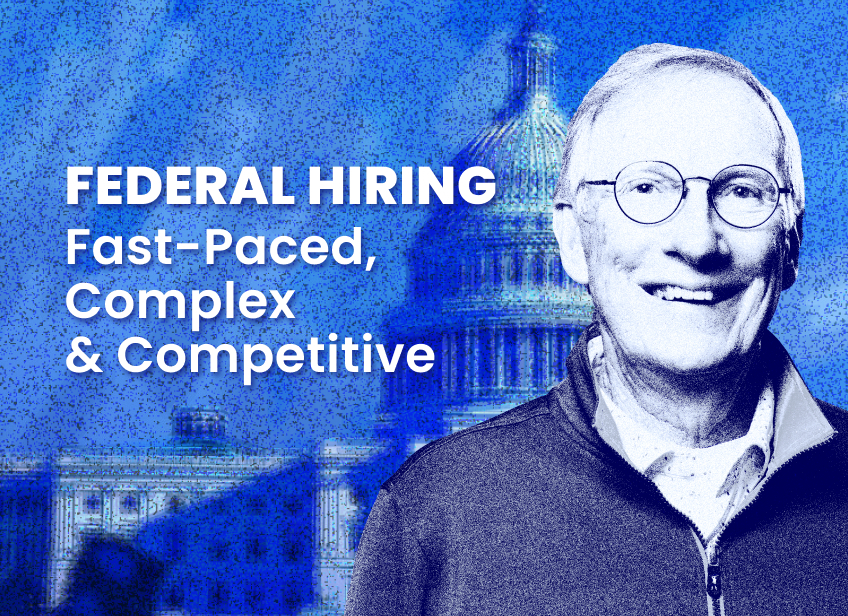
Government agencies can no longer simply post jobs and wait for applicants to find them. They’re competing with other federal organizations, as well as the commercial and private sectors, for specialized talent, navigating evolving digital platforms, branding, and working to meet heightened candidate expectations. All while maintaining fairness, transparency, and mission focus.
Understanding how federal recruitment arrived at this pivotal moment is essential for anyone hiring or considering a career in public service.
Few people are better equipped to explain that evolution than Joe Stix, Director of Federal Solutions at MarCom Group. With a career that began at the U.S. Civil Service Commission in the 1970s, continued through senior leadership roles at the Office of Personnel Management (OPM), and now spans more than 20 years at MarCom Group, Joe has seen federal recruitment from nearly every angle.
“Stay open-minded. Leave the ‘we’ve always done it this way’ mindset behind.”
“I started with the U.S. Civil Service Commission back in the 70s,” Joe shared. “So, I experienced the change to the Office of Personnel Management when the Civil Service Commission was abolished.”
When Joe entered public service, federal recruitment operated under a single, centralized model.
“Federal hiring was a standardized process where agencies would describe the jobs they wanted people to apply for,” he recalls. Every applicant used the same paper document: the SF-171. “That form enabled an individual to put in experience blocks… and every agency used that same form.” Hiring was standardized, paper-based, and centralized. If an agency needed candidates, it went to the Civil Service Commission, or later OPM, and waited for a list to arrive.
Agency-driven hiring put those closest to the mission in the driver’s seat.
Federal hiring began to change dramatically in the 1990s, driven by automation and a major policy shift known as Delegated Examining Authority. “OPM delegated to agencies the authority to do their own examining,” Joe explains. Rather than relying on a single central authority, agencies could now recruit and evaluate candidates themselves, while still posting jobs publicly. “USAJOBS was the system that agencies must use to publish their jobs,” he notes, “but USA Staffing became the automated process for individuals to follow in applying.” This marked the beginning of agency-driven hiring at scale.
“While tools, systems, and expectations will continue to evolve, the mission — and the people drawn to serve it — will endure.”
One of the most immediate impacts for hiring managers was a shift in speed. “Instead of waiting in line to get your list sent to you, you now… could establish your own lists,” Joe says. Hiring timelines, once undefined and unpredictable, became measurable. “Agencies were expected to hire within an 80-day model from start to finish.” That level of accountability simply didn’t exist before. “There really wasn’t one [timeline]. No one was looking at it.”
As the process modernized, so did the candidate experience.
The move away from the standardized form introduced detailed resumes, automated questionnaires, and validation of experience. “If you said you had seven years of engineering experience, your resume better reflect that,” Joe notes. Candidates also began comparing federal roles more directly with private-sector opportunities. While compensation wasn’t always on par with the private sector, the appeal of public service remained strong. “There are people out there who want to work for the federal government, period. They just get a calling… serving the public.”
A devoted following begins with a trusted brand.
Another major turning point was the rise of employer branding in federal recruitment. “In the early and late 90s, the process was simply, if you wanted a federal job, you found it on USAJOBS, and you applied,” Joe says. Agencies didn’t market themselves or explain how they differed from one another. That changed as agencies realized they needed to compete for talent. “They began to say, ‘We need to really differentiate and distinguish ourselves from other organizations.’” This shift opened the door to recruitment marketing, creativity, and trusted partnerships with vendors like MarCom Group.
Today, recruiting is targeted, data-driven, and competitive.
“Platforms like LinkedIn are game changers. “Years ago, I wouldn’t have thought you could find a metals inspector on LinkedIn,” he says. Now, agencies identify potential candidates, encourage them to apply, and still maintain open competition. “They’re not just taking them; they still have to apply like everyone else.”
What hasn’t changed is the need to adapt. “Stay open-minded,” he advises federal leaders and hiring officials. “Leave the ‘we’ve always done it this way’ mindset behind.” Adapt to the times and embrace your organization’s core mission. While tools, systems, and expectations will continue to evolve, the mission — and the people drawn to serve it — will endure.
About the Author
An expert in federal recruitment, Joe has more than five decades of experience shaping how the federal government hires talent. His career began at the U.S. Civil Service Commission in the 1970s, continued through senior leadership roles at the Office of Personnel Management, and now spans more than 20 years with MarCom Group, advising federal agencies as they navigate modern, competitive, and data-driven hiring. Amazingly, Joe stays connected, current and impactful providing advice and recommendations that are always on target!